An honest, practical look at on-land bookmaking — the events you can price, where the money comes from, and the discipline that holds the book together when the action starts moving.
Most calculators take odds and hand you probabilities. This one runs the other way — the operator's way: feed it your ratings of the runners, get a posted line with margin already built in.
It's easy to assume on-land bookmaking is a vestige — that online operators with bigger margins and global reach have made the rail-side bookmaker obsolete. They haven't. There is one structural feature of the on-land seat that online operators cannot reproduce at any price.
"The on-land bookmaker is the arbiter of the result. The online operator is not."
— The structural difference that defines the tradeOnline bookmakers, betting exchanges, prediction markets — they all settle outcomes against a result produced by someone else. They are settlers, not arbiters. The constraint is invisible from inside an online operation but enormous in effect: they can only run markets on events with an official, verifiable result feed. No feed, no market.
That's why online catalogues fill up with the fifteenth tier of Laotian badminton, the twenty-fifth division of Pakistani handball, regional cricket leagues nobody asked for. Those weren't chosen for player interest. They were chosen because somebody publishes their results.
The on-land bookmaker doesn't have this problem. The bookmaker accepts the bet, watches what happens, decides the outcome, pays out. The catalogue is bounded only by what the operator can witness and adjudicate.
A fair question from any aspiring operator: is this a real business, or a zero-sum trap dressed up as one? The answer depends entirely on who you're playing against.
There are three seats in the wider world of stakes-on-uncertainty. They look similar from outside and they are not the same trade.
The other people at the table are also pros. Money moves between roughly-matched opponents. The room takes rake on every hand. Most players, even good ones, bleed out over time.
The other side of the trade is professional. Spread and commission go to the broker on every position. Most retail traders bleed out faster than poker players do.
The other side is a recreational audience — not pros, not matched, mostly there for the experience of betting. The operator sets the price, takes a margin, manages a book. Over time the math is on the operator's side.
"Bookmakers don't play against each other. They play, with a structural edge, against a crowd that came for the contest."
— The durability of the on-land seatIf you can witness it and adjudicate it, you can price it. That single rule opens a catalogue the online industry cannot reach.
Players unknown outside the village. No scoreboard, no broadcast, no league record. Two regulars throw; the bookmaker watches; bets are paid. Routine in the British tradition.
Amateurs compete, the operator decides. Same structure as the pub, different room.
Twelve colleagues in a car park during a corporate event. Twenty seconds and one winner. With twenty dollars on each runner, the office talks about it for six months.
Subjective, contested, sometimes chaotic. The bookmaker's judgement is the result. Sub-markets work fine.
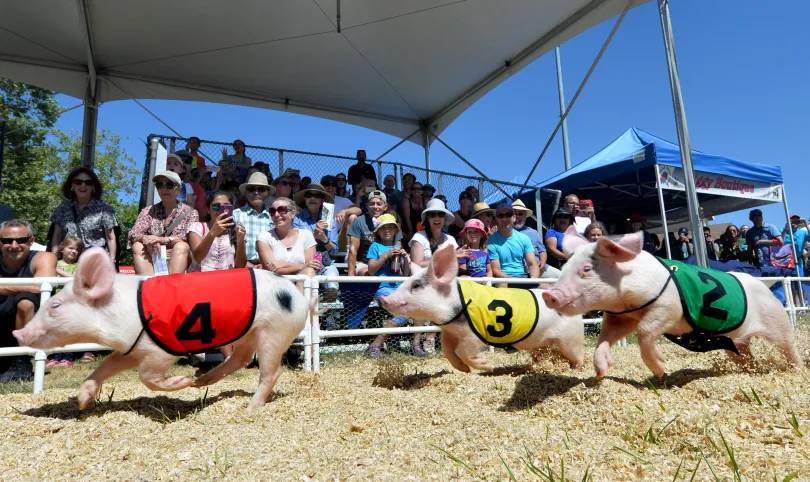
Pig races, greyhound trials, charity sprints. No governing body publishes a result. The bookmaker's eye is the result. Long tradition in on-land work.
The model scales to whatever the operator can physically attend. The only specification of an on-land market: a clear-enough outcome an attentive operator can call.
Before setting odds on anything, there's a more basic question: should you be pricing this event at all? It depends on who knows more about it — you, or the players.
Place both sides on a knowledge scale of three steps: High (you've studied the sport for years), Medium (you know the structure but aren't inside it), Low (you have little useful information). The matrix is the decision tool.
"The bookmaker must never be weaker than the player."
— The rule that makes the matrix workIf the player understands the event better than you do, the flow is toxic — every bet is, on average, a bet you're losing. There's no margin trick that fixes it. Walk away.
The interesting cell is the bottom-left: neither side knows. A pig race nobody outside the venue has heard of. In this cell the player has no edge either — they're not betting because they know more, they're betting because the event is fun. You set the prices, build in margin, take the action.
A few practical anchors before setting any line — what each band of odds means, where the margin lives, and the one rule that decides whether players bet or walk past.
Margin first. Two participants with equal chances at a clean 100% return would be priced 2.00 / 2.00. Bookmakers don't run clean lines; they keep margin. A typical industry return of 75–80% (margin of 20–25%) is accepted as the price of taking part.
Asymmetric lines in slot-mode events. The temptation is to publish even odds — 1.95 / 1.95. It's mathematically honest. It's also nearly invisible to players. Use even lines rarely. The working default is a small favourite and a small underdog — say 1.80 / 2.05.
On favourites. Most recreational players prefer to back the favourite — the favourite-longshot bias. This is exactly the shape an operator wants: a book that loads onto a favourite they're confident pricing, balanced by longshot money.
For two MMA fighters with roughly equal chances, offer 1.80 and 2.05 rather than 1.95 / 1.95. Players respond to the shape of the line, not the truth behind it. Even small misjudgements get corrected by the equalizer as bets load in.
Bets at 1.10–1.30 look unappealing to outsiders, but they are extraordinarily good for the book over time. Players who repeatedly back super-favourites at those odds lose heavily on the long run.
How each price band reads to the player and the book
| 1.1 | Super Favorite | Virtually certain winner — best odds for the bookmaker | |
| 1.2 | Very Good | Extremely strong favorite | |
| 1.3 – 1.4 | Good | Strong favorite, punter still losing long-term | |
| 1.6 – 1.8 | Punter Chance | Opponents have a good chance here | |
| 1.9 – 2.2 | Strong Favorite | Still going strong as favorite | |
| 2.3 – 2.6 | Favorite | Clear favorite | |
| 2.7 – 3.3 | Semi-Favorite | Semi-favorite territory | |
| 3.5 – 4.33 | Contender | Contender with good chances | |
| 4.5 – 6 | 1st Echelon | First echelon of win contenders | |
| 7 – 8 | 2nd Echelon | Second echelon of win contenders | |
| 9 – 12 | Slim Chance | Can claim victory under favorable circumstances | |
| 13 – 16 | Very Slim | Slim chances of victory | |
| 18 – 25 | Outsider | Opens the group with very slim chances | |
| 33 – 50 | Long Shot | Chances of winning are very slim | |
| 66+ | No Chance | Practically no chance of winning |
Writing the initial line is the easy part. The skill lives in moving it as bets come in. For any event you've decided to run, the basic method:
If you'd rather not do the arithmetic, the Bookieland calculator handles it: feed it your ratings, it returns a posted line with margin baked in.
Ratings in, posted odds out. Margin built in. Shape is clean — a clear top, two mid-favourites, middle-pack, and a longshot.
A bookmaker who has learned the math, the matrix and the line still has one thing left to acquire — the habits that decide whether they survive the trade or quietly leave it.
"Army half-joke: rule one — the commander is always right; rule two — if the commander is wrong, see rule one."
— On the bookmaker's authority over their own oddsPlayers push constantly — cancel my ticket, refund this, the price was wrong. Cancelling one or two bets in a hundred has no real consequence. Beyond that, firmness becomes caprice. The sentence that holds it together: "This is my decision. If you don't like it, go to another bookmaker."
A bookmaker who folds under pressure is, in the player's frame, not worth beating — they were going to give the money back anyway. A bookmaker who holds the line is a real opponent. Beating a real opponent is the actual reward of the trade.
Honesty isn't a moral preference; it's the operating layer. A bookmaker known to be dishonest doesn't get bets brought to him. Players walk past his stall to someone whose word holds. Within a year or two, no book.
Never give the impression you're sometimes short of cash. Players read this signal instantly, leave, and tell other players. Dress one step above what's required, handle the cash drawer calmly, pay winners quickly and visibly. The seat is performed, not just occupied.
On-land bookmakers at the same venue aren't rivals; they're colleagues. A race goes against you, the float runs short — you walk to a peer next to you, borrow cash on the spot, pay out within three to five minutes. Without that network, "always pays" breaks on the first bad day.
Credit: losing players who go on credit often simply don't pay; you lose both the money and the customer. Minimise. Whales: one player carrying a large share of your handle looks like a windfall and ends as a single point of failure.
At any racetrack in any country, punters overwhelmingly place their bets in the final three minutes before the race. Punters don't want others diluting their potential payouts. The bookmaker who understands this rush positions themselves before it arrives.
"The seat opens early in adult life — around twenty, once a person has felt the real value of money. Fifty, sixty, seventy are all fine entry points; this trade rewards attention and judgement, not speed."
— On who can sit hereWriting the initial line is the easy part. The skill lives in moving it as bets come in — and the equalizer is the bookmaker's most powerful tool for it.
Online bookmakers use an equalizer to balance the load on odds — adjusting quotes automatically as bets come in. Our on-land bookmaker application uses a similar equalizer built to industry standards.
While on-land bookmakers can manually change odds at any time, the equalizer handles this automatically and quite effectively. Its use virtually eliminates large losses for the bookmaker.
Even if you make a slight mistake with your initial odds, the equalizer will correct the imbalance as betting load accumulates — wrong odds self-signal: action loads onto the mispriced side, and the line moves to fix it.
Bet Load Distribution — Live Equalizer
Equalizer automatically adjusts odds as bets load in
A short map of the working tools that sit alongside this guide. Each is a separate piece of the on-land bookmaker's kit.
The web tool for on-land operators — take bets, balance the book, work the pre-event rush without dropping action. Runs in any browser, installs as an app.
app.bookie.land →Turns your intuitive ratings of the runners into a clean set of odds with margin baked in. Free, no sign-up.
app.bookie.land/calc →Direct support channel. Questions about the trade, the tools, or anything in this guide.
Contact →True stories from the world of bookmakers and racetracks in Eastern Europe — told by a man who was there.
Before the Berlin Wall came down, there was almost nowhere in Eastern Europe to win real money. I mean that plainly — almost nowhere.
The fall of the Berlin Wall, in 1989, was when socialism began to fall apart. Only after that did the casinos arrive, and the slot machines, and all the rest of it. Before it, there was none of that.
In the West, they had the big betting shops: names like William Hill and Paddy Power. A man could walk in off the street and put money on almost anything. In the East, we had none of that. No betting shops. No casinos. Nothing at all.
We had one place. The racetrack.
So that is where people brought their luck and their nerve — because there was nowhere else to bring it. And the betting was simple: a ticket cost about half a dollar, and you bet into the pool, against everyone else who had put their money in.
Most days you won a little, or you won nothing. The real money was in one hard bet: you had to name the first three horses in the exact order they finished — first, second, and third. They called it the tricast (in some countries, a trifecta). In a race of twelve or fourteen horses, getting it right was almost impossible.
And yet I know of two such cases — both on big prize races — where a man held a single ticket with the right three names, in the right order. Back then, big money was counted in bottles of cognac, and each of those tickets was worth three to four thousand of them. Paid in cash, of course — in one go, from half a dollar.
Work out what that is in today's money, and you will understand why people came. One track. One ticket. The only chance in the whole country to win big. These are stories from those times.
I did not witness this myself. The story was already part of racecourse folklore by the time I heard it.
According to several old racing men, the incident took place sometime in the 1970s during a trotting race. The horses were already on the home stretch. The race was almost over. Thousands of spectators were watching.
And for reasons that apparently had very little to do with the race itself, two drivers decided that the final meters of the contest would be a good time to settle an old disagreement. They began striking each other with their whips.
Not after the race. Not in the stables. Not in the parking lot. During the race. Both men were still driving their horses while exchanging blows in front of the grandstand.
The whips were not ceremonial decorations. Every driver carried one. And every spectator could see exactly what was happening.
Whenever old racecourse people told the story, they usually laughed. Not because it was admirable. But because it perfectly captured the spirit of those years.
People often imagine racecourses as places of elegance, manners and gentlemen's behaviour. Sometimes they were. And sometimes two drivers reached the home stretch and decided that finishing the race could wait until they settled a personal matter.
— The Oddsman
This is not really a story. More of a small sketch. The entire incident lasted perhaps twenty seconds.
One afternoon, after the races had finished, A.N., a professional watcher we both knew, and I were walking away from the racecourse. We had already left the track and were heading toward the city when A.N. suddenly became very serious.
He looked at both of us and said: "Listen carefully. Whatever you do, don't sleep with Penelope." Then he added: "If you do, you'll have very serious problems."
The warning was delivered with complete conviction. No smile. No grin. Nothing.
I immediately started wondering what exactly he meant. Was there some influential man behind her? Some old scandal? Some hidden story I didn't know about? The warning sounded far too serious to ignore.
The funny part was that Penelope was one of the bookmakers at the track. She was already well past her youth, thin, rather ordinary-looking, and certainly not the sort of woman most racing men would have considered irresistible. The whole thing made absolutely no sense.
The more I thought about it, the less sense it made. Finally I asked our companion what A.N. was talking about. He immediately started laughing. "It's nonsense," he said. "Just a joke."
That was all. No secret. No scandal. No mystery. Just A.N. delivering a completely absurd warning with such a serious face that for a few moments I genuinely believed there had to be something behind it.
Looking back, I think that was part of his talent. He could tell a joke without smiling. And somehow that made it even funnier.
— The Oddsman
This was another story A.N. told me. It happened many years ago, after the racing had finished for the day.
Like many racecourses of that era, there were places nearby where people gathered after the last race. Small tables. Benches. Conversations that often lasted longer than the racing itself. Bettors, insiders, horsemen and racing people would sit together, talk about the day and, quite often, share a drink.
Eastern Europe was different back then. People did not always drink in tiny measures. A glass could be a glass. And among racing men, hospitality followed its own rules.
One evening, A.N. was sitting with a group of regulars after the races. They were talking, drinking and discussing the events of the day. Then another man approached the table. He belonged to the racing world, but he was not particularly popular. For one reason or another, many people around the track disliked him.
He looked at the bottles on the table and smiled. "You gentlemen seem to be enjoying yourselves," he said. "Any chance I could get a drink?"
One of the men at the table smiled back. "Of course." A glass was filled. A generous one. The newcomer thanked them and raised it. Everything appeared friendly.
He took a drink. Then another. By the time the glass was halfway empty, the man who had offered it suddenly struck the bottom of the glass with the palm of his hand.
The result was immediate. Glass shattered. Teeth shattered. Blood followed. The gathering ended very quickly after that.
When A.N. told me the story years later, he did not tell it as a joke. Nor as a heroic tale. He told it simply as a reminder that the racecourse world of those years was not always a gentle place.
People spoke differently. Drank differently. Settled disputes differently. And sometimes a smile did not mean what it appeared to mean.
— The Oddsman
This was one of the stories A.N. told me. The events took place sometime in the 1970s, long before mobile phones, text messages or betting apps. Back then, information travelled through people. And the smartest people worked very hard to hide where it was going.
At the time, A.N. was somewhere between a watcher and a third-tier insider. He spent most of his time observing. Looking. Waiting. Trying to understand who knew more than everyone else.
One day he noticed something unusual. Not a large bet. Not an argument. Not a conversation. Just a small folded piece of paper. One of the strongest insiders at the track briefly passed a note to a completely ordinary-looking man. The exchange lasted only a second. Most people would never have noticed it. A.N. did.
What interested him was not the note. It was the man. Nobody seemed to know him. Nobody paid attention to him. He was not one of the familiar faces around the track. That made him interesting.
A.N. began watching him. Slowly he became convinced that this man was receiving information from the very top of the ladder. The first tier. The people who created information rather than received it.
But there was a problem. A.N. knew something else. People were watching him too. The racecourse was full of watchers. Some watched insiders. Some watched bettors. Some watched other watchers. If A.N. suddenly started following this mysterious man and betting behind him, sooner or later somebody would notice.
So he did something clever. He recruited an outsider. A man from a research institute who had absolutely nothing to do with racing. No one knew him. No one watched him. No one had any reason to. A.N. gave him a simple instruction. "Watch that man. Bet what he bets."
That created a chain that was almost invisible. Information moved from the first-tier insider to the man with the note. The man with the note placed his bets. The outsider followed him. And A.N. followed the results. Nobody connected the pieces. Nobody knew the outsider. Nobody knew why he was betting. And nobody connected him to A.N.
Years later, A.N. laughed when he told me the story. "For several months," he said, "I was swimming in money."
The funny thing is that it all began with something most people would never have noticed. A tiny piece of paper changing hands for a single second. Sometimes that was all it took.
— The Oddsman
Before I continue, I should introduce a man who appears in many of these stories. I will simply call him A.N. Those initials are enough.
A.N. was around fifteen years older than me. When I knew him, he was already one of the best-informed people at the racecourse. Over the years he had been many things. Sometimes a watcher. Sometimes an insider. Sometimes somewhere in between.
Most of the time he operated between the second and third tiers of the information ladder. Occasionally he reached the first tier. He knew people. He knew drivers. He knew bettors. He knew who was watching whom. And, perhaps most importantly, he knew how information moved.
Earlier in life he had served time for fraud. Nothing particularly violent. The kind of offence that was not unusual among racecourse people of that era. Yet he was not a stereotypical criminal. He was intelligent. Well-spoken. Educated. Curious. He could spend an hour discussing horse racing and another hour discussing literature, history or politics.
Many people watched him. Professional watchers followed him. Amateur followers followed him. And sometimes he watched them right back. He was perfectly capable of placing false bets simply to create confusion. And on occasion he even acted as a watcher himself. The racecourse was a game within a game, and A.N. understood both sides.
About fifteen years ago I asked him something. I said: "If I ever use your stories, would you mind?" His answer was immediate. "Not at all. Use whatever you want." At the time I did not realise how valuable that permission would become.
Looking back, one of my regrets is that I did not ask him more questions. He had spent decades around racecourses. He had seen things from several different sides. The stories I managed to collect are only a small fraction of what he could have told. Perhaps one thirtieth. Perhaps even less.
But what remains is enough. And many of the stories that follow come either directly from A.N. or from a world he helped me understand.
— The Oddsman
Before telling individual stories, it is worth explaining how information moved around the racecourse in those years. There were several levels of insiders.
The first tier consisted of the people who created information themselves. They spoke directly to drivers, trainers and horsemen. They arranged things, cancelled things, paid people, influenced races and knew exactly what was happening.
The second tier received information from the first tier. They were still dangerous bettors, but they were not usually the source.
The third tier lived on information that had already travelled some distance. Sometimes it was excellent. Sometimes it was incomplete. Sometimes it was wrong. But many of them were still respected and successful players. One of the men mentioned in another story — the bettor whose combination was ruined when a horse broke down while running third — belonged to this third tier.
Then there was another group altogether. The watchers. Not the amateur followers who ran behind successful bettors from window to window — those existed too, and people called them "locomotives" and "wagons". The professional watchers were different. They operated like organised teams.
This was before mobile phones existed. Yet somehow they still gathered information, communicated with each other and knew who was meeting whom. They watched the entire racecourse. The betting windows. The paddock. The stables. The restaurants. The bars. The corners where people thought nobody was looking.
Some of them used binoculars. Some specialised in recognising faces. Some knew exactly which messenger belonged to which insider. Several independent groups operated around the racecourse at the same time. Usually between two and five people in each group.
The insiders knew the watchers existed. The watchers knew the insiders knew. Both sides tried to deceive each other. False tickets were purchased. False information was spread. Friends placed bets on behalf of other people. And the game continued.
One important detail is often misunderstood. The strongest insiders usually bet through the totalisator, not through bookmakers. Bookmakers had payout limits. The totalisator did not. That is where large money could be won. That is also why the watchers paid so much attention to betting windows — not because betting windows themselves were important, but because they were often the final destination of information that had travelled through several layers of people.
And this explains something that happens at racecourses all over the world. Most serious betting appears in the last few minutes before the start. The reason is simple. Insiders do not want to give watchers time to react. And watchers do not want to miss the final move.
That battle has existed for generations. Long before mobile phones. Long before the internet. And long before anyone started calling it information warfare.
— The Oddsman
Some stories belong to a time that is already gone.
Eastern Europe after the old system collapsed was not like the regulated betting world people imagine today.
Money moved in cash. People knew each other by face. Information travelled through drivers, trainers, riders, owners, friends, enemies and men who never gave their names twice.
Some things happened openly. Some things happened quietly. Some things were never said at all, but everyone understood them.
To someone from Britain or America, many of those stories sound wild. To people who were there, they were not wild. They were normal.
A bookmaker learned fast in that world. Not from books. Not from courses. From pressure. From mistakes. From men who came to the window knowing more than they should. From races you should not have priced. From winners you paid quickly because reputation mattered more than argument.
That world was hard. But it made strong bookmakers.
A good bookmaker is not built in a comfortable room. He is built under fire.
— The Oddsman
Every track had ordinary players. Then it had chargers.
A charger did not bet for fun. He did not come to the window because he liked a horse's colour, or the jockey's name, or some lucky number. He came because he believed he knew something.
Bookmakers knew them. Players knew them. Cashiers knew them.
Sometimes they bet at the tote because bookmakers would not take enough from them. Sometimes they came to bookmakers who could handle the risk.
I took those bets when I could. But I never treated them like ordinary money.
A charger carries information. Not always correct information. Not always complete information. But information.
If one charger backs a horse, you notice. If two chargers back the same horse, you move. If three arrive, you stop thinking about whether you like the horse and start thinking about your book.
That is the difference between a player and a bookmaker. A player asks: Will it win? A bookmaker asks: What happens to me if it wins?
— The Oddsman
A bookmaker does not have to price every race. That sounds simple. Many beginners do not understand it. They think a bookmaker must always take action. Every race, every runner, every player, every bet.
No.
There were races I simply refused. Not because I was afraid of work. Not because I had no money. Because I did not understand the race.
Sometimes you looked at the field and something felt wrong. Too many unknowns. Too many strange connections. Too many runners whose real intentions were not clear.
In that situation, the best book is no book.
Players do not like hearing that. They come to bet. They want a price. They ask why you are not taking it.
You do not need to explain too much. You just say: No. I am not taking this race.
That is part of the trade. A bookmaker who cannot say no will eventually meet a race that says no for him.
— The Oddsman
People who have never spent real time at a racecourse imagine it wrongly. They think it must be noise, fights, shouting, drunken arguments and constant trouble.
It was not like that. At least not where I spent my years.
The crowd was mixed in a way you rarely see anywhere else. Former criminals. Actors. Professional gamblers. Small businessmen. Retired men. Ordinary workers. People who had money. People who only looked like they had money. People who had no money at all but still came every week.
Later I understood that a large part of that crowd had a past. When I was young, I did not see it. They were just racecourse people to me.
And yet the place was surprisingly quiet. In thirty years I saw only a few fights in the stands. Three or four, maybe. Short fights too. Nothing like the chaos outsiders would imagine.
The racecourse had its own order. People could owe money, win money, lose money, hate each other, follow each other, cheat each other, and still stand side by side watching the same race.
That was the strange beauty of it. A racecourse was not only a place where horses ran. It was a small republic of people who needed risk in their lives.
— The Oddsman
Some stories from the old tracks sound unbelievable if you tell them in London or New York. That does not mean they were impossible. It means the world was different.
In the early 2000s, a man came from a neighbouring country to visit a player I knew. He was not a casual racing man. At his own track he was considered important. One of those people who did not talk too loudly, because he did not need to.
Later my player told me the story this man had told him.
According to him, once he had managed to remove the whole field from winning. Not one horse. Not two. The whole race. Eight runners, and none of them were really supposed to win.
Of course somebody had to finish first in the end. A race cannot end with no winner. But the point was not the result. The point was that the race itself had been turned into something else.
I cannot prove the story. I did not see that race. But I saw the man.
He did not look like a drunk telling fairy tales in a buffet. He looked exactly like the kind of man who could say such a thing and mean it.
That was also part of the old racing world. Some stories were never written down. But people who were there knew which ones could be true.
— The Oddsman
There are bets you lose from the start. There are bets you lose because your judgement was poor. And then there are bets that are almost won, right until the race itself decides otherwise.
I once saw a man put money on a straight triple. First, second, third. Not boxed. Not flexible. Exact order.
It was not a small bet either. A serious amount for that kind of wager. He placed it just before the start.
The race began, and everything started to fall into place. Coming into the home stretch, the order looked almost fixed. First was first. Second was second. Third was third. There were gaps between them. Not inches. Proper gaps.
At that point, most people watching would have said the bet was already home.
Then the horse in third broke down. Just like that.
No calculation survives that. No insider survives that. No perfect ticket survives that.
The combination was gone in one second.
People often think that if somebody knows enough, they are safe. They are not. Racing always keeps one card for itself.
— The Oddsman
Every racetrack has its own wildlife. At ours, they were called trains.
A train was an insider. A bettor whose selections were respected by almost everyone. The moment he approached a betting window, people started watching. Then following. Then running.
Behind every train came the wagons. Sometimes ten of them. Sometimes twenty.
Their job was simple. See what the insider backed and do exactly the same. If he bet Horse Number Four, they wanted Horse Number Four. Immediately. Before the odds moved.
The funny part was that some wagons were following other wagons. They had lost sight of the original train long ago. All they knew was that somebody in front was running somewhere important.
Sometimes the insider knew he was being followed. He would place a false bet. Half the wagons would charge in the wrong direction. The real money would quietly appear somewhere else.
The best days were when the whole crowd started moving. You could see people rushing from window to window, trying to keep up. By the end there was a train, wagons, and wagons following wagons.
To an outsider it must have looked ridiculous. To us, it was just another day at the races.
— The Oddsman
Every bookmaker in the world has a limit. Some call it a liability limit. Some call it a payout ceiling. The name doesn't matter. The principle does.
One bookmaker at the track didn't believe in limits. He liked to show people how much money he had. He liked people to know that he would take any bet. No restrictions. No ceiling. No fear.
The other bookmakers thought he was crazy.
For months he accepted bets without understanding the risk he was carrying. Then one day a race came along that was simply too expensive for him.
Whether it was inside information, a manipulated race, or just a perfectly organised betting operation doesn't really matter. What matters is that he had written a ticket he could not afford to pay.
The payout was enormous. For those days, life-changing money.
After that race nobody saw him at the track again.
Good bookmakers don't survive because they are brave. They survive because they know exactly how much they can lose.
— The Oddsman
One thing I learned very early is that information travels faster than horses.
I was standing in the ring, taking bets as usual. A race for young horses. Nothing extraordinary at first glance.
Then somebody backed a horse at 25-1. Not unusual.
A few minutes later another bettor appeared and backed the same horse. Then another.
These were not ordinary punters. These were the kind of people who rarely placed a bet unless they knew something.
The price dropped. 25 became 12. 12 became 7. 7 became 3.5.
At that point the horse had gone from outsider to one of the market leaders.
The race started. The jockey immediately sent the horse to the front. Halfway through the race it was travelling strongly and pulling away from the field.
For a moment it looked as if the insiders had been right all along.
Then, approaching the home stretch, the horse broke stride. Everything changed in a second.
The horse lost momentum, rivals swept past, and what looked like a certain winner finished well behind the leaders.
The information had been correct. The betting had been correct. The market had been correct.
The result was wrong.
That happens more often than people think.
— The Oddsman